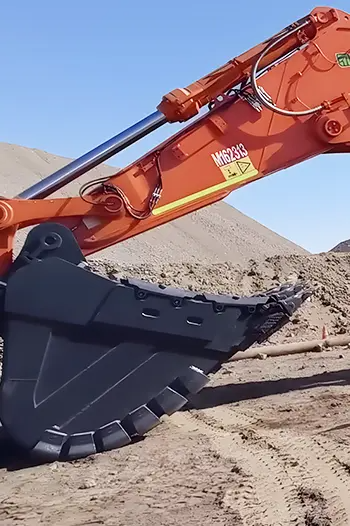
Introduction
Choosing the right Excavator can decide how fast a project moves and how much it costs. Many types exist, each built for different ground and workloads. In this article, you will learn how each Excavator type fits real job needs and efficiency goals.
Overview of the 7 Main Types of Excavators
Excavators are designed in multiple configurations to handle different terrains, workloads, and precision levels. From a buyer’s perspective, knowing how each excavator type behaves on site helps reduce selection risk and improves productivity.
When paired with durable buckets and attachments from YF Bucket Machinery, the right excavator setup can adapt to demanding working conditions while extending service life.

Crawler Excavators: Tracked Stability for Heavy-Duty and Uneven Terrain
Crawler excavators use tracked undercarriages to distribute weight evenly and improve grip. They perform reliably on mud, sand, and slopes where wheeled machines lose traction. These excavators are common in mining, foundation digging, and large earthmoving tasks.
Typical strengths include:
● Strong stability on uneven ground
● High digging force for deep excavation
● Compatibility with heavy-duty and rock buckets
Wheeled Excavators: Fast Mobility for Urban and Road Construction
Wheeled excavators focus on speed and convenience on hard surfaces like concrete and asphalt. They suit city projects where frequent relocation is required. Operators value their ability to move quickly without transport trucks.
They are often chosen for:
● Road and municipal construction
● Short-cycle excavation work
● Jobs needing quick attachment changes using couplers
Dragline Excavators: Cable-Based Systems for Large-Scale Dredging and Mining
Dragline excavators use a cable and hoist system instead of a hydraulic arm. This design allows long-distance digging and excavation below machine level. They are typically assembled on site due to size.
Best suited for:
● Mining operations
● Canal and river dredging
● Large infrastructure excavation zones
Suction Excavators: High-Precision Excavation for Underground Utilities
Suction excavators remove soil using air or water and a powerful vacuum system. They reduce the risk of damaging underground utilities. These machines are favored in sensitive urban environments.
Key advantages include:
● High excavation accuracy
● Minimal disruption to surroundings
● Improved safety around cables and pipelines
Skid Steer Excavators: Compact and Agile Machines for Small Job Sites
Skid steer excavators are compact and highly maneuverable. Their attachment layout supports work in tight residential or renovation areas. They handle light excavation and cleanup tasks efficiently.
Common applications include:
● Debris removal
● Shallow digging
● Multi-task jobs using interchangeable attachments
Long Reach Excavators: Extended Boom Solutions for Demolition and Over-Water Work
Long reach excavators feature extended booms for working at a distance. They are used where direct access is unsafe or impossible. These machines improve safety by reducing repositioning needs.
They are ideal for:
● Demolition near water
● Riverbank maintenance
● Hard-to-reach excavation areas
Mini Excavators: Compact, Zero Tail Swing Machines for Confined Spaces
Mini excavators are designed for precision in narrow spaces. Their reduced or zero tail swing allows safe operation near obstacles. They are easy to transport and simple to operate.
Typical use cases include:
● Landscaping projects
● Indoor or fenced construction areas
● Utility trenching in tight zones
Excavator Type | Typical Environment | Primary Advantage |
Crawler excavator | Uneven or soft terrain | High stability and digging force |
Wheeled excavator | Urban, paved surfaces | Fast movement and flexibility |
Dragline excavator | Mining and dredging | Long-distance excavation |
Suction excavator | Underground utilities | Precision and safety |
Skid steer excavator | Small job sites | Compact versatility |
Long reach excavator | Demolition, water areas | Extended working range |
Mini excavator | Confined spaces | Excellent maneuverability |
Choosing an Excavator Based on Job Site Conditions
Job site conditions often decide whether an Excavator performs efficiently or struggles. Ground type, surface hardness, and available space all influence stability, mobility, and attachment choice. When these factors align correctly, productivity improves and equipment wear drops.
Many contractors rely on compatible buckets and attachments from YF Bucket Machinery to fine-tune Excavator performance under different site conditions.

Soft, Muddy, or Uneven Terrain
Crawler Excavators are commonly selected for unstable ground. Their tracked undercarriage spreads weight evenly, helping the Excavator maintain balance and traction. They handle slopes, loose soil, and wet areas better than wheeled machines.
Heavy-duty and rock buckets support continuous digging in abrasive environments and reduce downtime caused by wear.Typical working scenarios include:
● Mining and quarry operations
● Foundation excavation on soft soil
● Large-scale earthmoving on uneven terrain
Hard, Flat, and Urban Surfaces
Wheeled Excavators perform well on concrete, asphalt, and paved roads. They move faster between work zones, which saves time on urban projects. Operators often use standard digging buckets and quick couplers to switch tools efficiently. These Excavators fit city construction where relocation speed matters more than extreme traction.They are often used for:
Road construction and repair
● Municipal utility installation
● Urban trenching projects
Confined Spaces or Obstacle-Rich Areas
Mini Excavators and skid steer Excavators suit narrow or crowded environments. Their compact size allows precise movement near buildings and obstacles. Mini buckets and compact attachments improve control while reducing ground damage. These Excavators support safe operation where space limits machine size and swing radius.
Job Site Condition | Recommended Excavator | Key Advantage |
Soft or muddy ground | Crawler Excavator | High stability and traction |
Urban paved areas | Wheeled Excavator | Fast movement and mobility |
Tight spaces | Mini or Skid Steer Excavator | Compact and precise control |
Choosing an Excavator Based on Project Scale and Workload
Project size and workload intensity directly affect Excavator selection. Small residential jobs require precision and flexibility, while large infrastructure projects demand power and endurance.
Matching Excavator size to workload helps control operating costs and avoids unnecessary wear. Buckets and attachments designed for the right scale further improve efficiency.
Small-Scale and Residential Projects
Mini Excavators and skid steer Excavators fit small jobs where precision matters.
They minimize surface damage and move easily in tight areas. Their lower fuel use and simple transport reduce overall project cost. These Excavators are common in landscaping, residential trenching, and renovation work.
Medium-Scale Construction and Utility Work
Wheeled Excavators and standard crawler Excavators balance power and versatility.
They handle repetitive digging tasks while supporting multiple attachments. Contractors prefer them for utility work where conditions vary across the site. Their compatibility with different buckets increases task flexibility.
Large-Scale Earthmoving, Mining, and Infrastructure Projects
Crawler Excavators and dragline Excavators dominate heavy-duty projects. They manage continuous workloads and large material volumes. These Excavators support deep excavation and bulk handling over long periods. Reinforced buckets and structural attachments are essential to maintain durability.
Project Scale | Suitable Excavator Type | Typical Benefit |
Small | Mini or Skid Steer Excavator | Precision and low cost |
Medium | Wheeled or Crawler Excavator | Balanced performance |
Large | Crawler or Dragline Excavator | High capacity and durability |
Choosing an Excavator Based on Operational Goals and Efficiency
Operational goals shape how an Excavator should be configured and used on site. Productivity, flexibility, and maintenance control all affect long-term cost and job speed. When Excavator size, attachments, and wear parts work together, it runs smoother and lasts longer.
Many contractors improve efficiency by pairing machines with durable buckets and components supplied by YF Bucket Machinery.
Maximizing Productivity and Digging Efficiency
Productivity depends on balance rather than raw power. An oversized bucket slows cycle time, while an undersized one wastes capacity. Hydraulic output, bucket size, and material type should align. When they match, the Excavator digs faster and uses fuel more efficiently.
● Key considerations include:Bucket capacity matched to Excavator weight
● Hydraulic flow supporting consistent digging force
● Reduced cycle time during repetitive excavation
Improving Versatility with Attachments
Attachments allow one Excavator to perform many tasks without changing machines. Augers drill holes, breakers handle concrete, clamps move irregular materials, and quick couplers reduce tool change time. This flexibility helps crews respond quickly to changing job demands.
● Operational benefits often include:Fewer machines needed on site
● Faster task switching during projects
● Better return on Excavator investment
Reducing Downtime and Maintenance Costs
Downtime usually starts at wear points such as bucket edges, teeth, and joints. Durable excavator buckets and wear-resistant parts extend service intervals. Easy-to-replace components also reduce labor time during maintenance. Over time, these details lower total operating cost.
● Common efficiency gains come from:Reinforced bucket structures
● Standardized, replaceable wear parts
● Reduced unplanned maintenance stops
Operational Goal | Excavator Setup Focus | Efficiency Result |
Higher productivity | Balanced bucket and hydraulics | Faster digging cycles |
Greater versatility | Multiple attachments and couplers | More tasks per machine |
Lower maintenance cost | Durable buckets and wear parts | Reduced downtime |
Conclusion
This article explains how each excavator type fits different terrain, scale, and efficiency goals.Choosing the right excavator improves safety, speed, and overall project control.YF Bucket Machinery adds value through durable buckets, flexible attachments, and reliable service support.
FAQ
Q: What is an Excavator used for?
A: An Excavator is used for digging, lifting, trenching, and material handling across many job sites.
Q: How do I choose the right Excavator type?
A: Choose an Excavator based on ground conditions, project size, and required digging efficiency.
Q: Why does Excavator bucket selection matter?
A: Excavator buckets affect cycle time, wear rate, and overall digging performance.
Q: Are Excavator attachments worth the cost?
A: Excavator attachments expand machine functions and reduce the need for extra equipment.
Q: How can an Excavator reduce maintenance downtime?
A: An Excavator runs longer using wear-resistant buckets and easy-to-replace components.


