
+86-18913476038

Views: 0 Author: Site Editor Publish Time: 2026-03-26 Origin: Site


What makes mini excavatorsso powerful on any jobsite? It is not just the machine, but the mini excavator attachments.
In this article, we explore different attachment types and their uses.You will learn how each tool improves efficiency and helps complete tasks faster.
Standard buckets are the most commonly used mini excavator attachments on any jobsite. They are designed for everyday digging, loading, and backfilling tasks. Most operators rely on them because they provide a good balance between strength and flexibility. It works well across different soil types, especially in general construction and utility work.
They handle multiple tasks without needing frequent changes, which improves workflow.
It performs efficiently in soft to medium soil conditions, including sand and clay.
They are widely used for foundation digging, trench backfilling, and site preparation.
When choosing between standard and general-purpose buckets, users often consider working conditions. A general-purpose bucket offers slightly more flexibility, while a standard bucket focuses on consistent digging performance. Many manufacturers, including YF Bucket, design these buckets with reinforced edges to improve durability over long-term use.
Trenching buckets and mini buckets are built for precision work. These mini excavator attachments feature a narrow profile, allowing operators to dig clean and controlled trenches. They are especially useful when working on projects that require accuracy, such as pipe laying or cable installation.
They minimize unnecessary soil removal, which reduces cleanup time.
It allows operators to work efficiently in tight or confined spaces.
They are commonly used in urban construction, landscaping, and utility installation.
Mini buckets go even further in terms of compact size. They are ideal for detail-oriented work where precision matters more than volume. Because of their smaller footprint, they also improve visibility during operation, helping operators maintain better control. This makes them a preferred choice for delicate excavation tasks.
Grading buckets and clean-up buckets are designed for surface finishing rather than heavy digging. These mini excavator attachments are wider and have a smooth cutting edge, which allows for even leveling of soil. They are commonly used after excavation is complete, when the goal is to create a clean and uniform surface.
They help achieve smooth and professional ground finishes.
It improves efficiency when working on large flat areas.
They are widely used in landscaping, roadwork, and site finishing projects.
Unlike digging buckets, grading buckets focus on precision across the surface. Operators often use them to shape slopes, level ground, or prepare areas for paving. Their wide design reduces the number of passes needed, which saves time and improves productivity.
Skeleton buckets and screening buckets are specialized mini excavator attachments used for separating materials. Their open structure allows smaller particles like soil to pass through, while larger materials such as rocks or debris are retained. This makes them highly useful in projects that involve sorting or recycling materials.
They reduce the need for additional screening equipment on-site.
It allows operators to separate materials directly during excavation.
They are commonly used in demolition, site preparation, and landscaping projects.
Skeleton buckets are simpler and more durable, making them suitable for basic separation tasks. Screening buckets, on the other hand, offer more advanced sorting capabilities and higher efficiency. Both types help streamline workflows by combining excavation and material processing in a single step.
Quick Comparison of Core Mini Excavator Attachments
| Attachment Type | Primary Function | Best Use Case | Key Advantage |
|---|---|---|---|
| Standard Bucket | General digging | Construction, foundation work | Versatile and durable |
| Trenching Bucket | Narrow trenching | Pipe and cable installation | High precision |
| Mini Bucket | Detail excavation | Tight spaces, landscaping | Maximum control |
| Grading Bucket | Surface leveling | Landscaping, roadwork | Smooth finish |
| Skeleton Bucket | Material separation | Site prep, debris sorting | Simple and efficient |
| Screening Bucket | Advanced sorting | Recycling, demolition | High productivity |
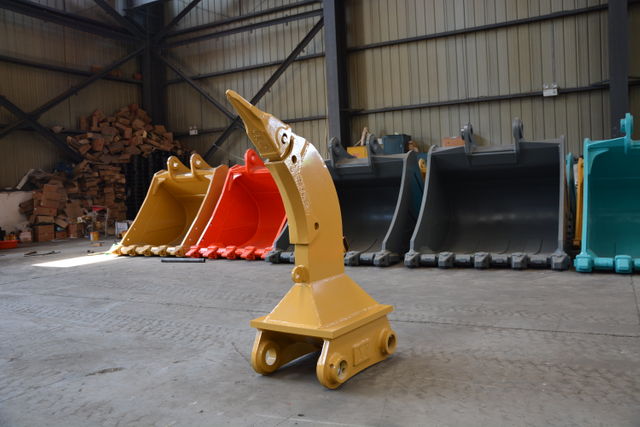
Rippers are one of the most practical mini excavator attachments when standard digging tools cannot penetrate the ground. They are designed to break up compacted soil before excavation begins. Instead of forcing a bucket into hard layers, operators use a ripper to loosen the surface first. It reduces resistance and improves overall digging efficiency.
They are ideal for hard-packed soil, frozen ground, and rocky terrain. It helps avoid excessive wear on buckets. It also reduces machine strain during operation.
It allows better control when starting trenches or preparing uneven ground. Operators can focus on precision rather than force. This improves safety on challenging sites.
They are commonly used in site preparation, road construction, and land clearing. It works especially well where roots or dense materials are present.
Hydraulic breakers, also called hammers, are powerful mini excavator attachments designed for demolition and heavy-duty breaking tasks. They deliver repeated impact force to break materials such as concrete, asphalt, and stone. It transforms a compact excavator into a demolition-ready machine.
They are widely used for breaking concrete slabs, asphalt roads, and foundations. It allows operators to handle demolition without additional equipment.
It provides high-impact energy, which makes it effective for hard surface removal. Operators can work faster even in dense materials.
They are essential in road repair, construction, and renovation projects. It helps remove old structures before rebuilding begins.
Unlike standard attachments, hydraulic breakers focus entirely on impact performance. They require proper handling and maintenance to ensure consistent output. When paired with a quick coupler, operators can switch between digging and breaking tasks quickly, which improves productivity across the jobsite.
Compaction attachments are designed to compress soil and improve ground stability. These mini excavator attachments are often used after trenching or excavation work is complete. Instead of relying on manual compactors, operators can use the excavator itself to finish the job efficiently.
They are used for compacting soil in trenches, foundations, and backfilled areas. It ensures the ground is stable before construction continues.
It reduces air gaps in soil, which improves load-bearing capacity and prevents future settling. This is important for long-term structural integrity.
They are commonly applied in utility installation, roadwork, and foundation preparation. It helps meet construction standards more easily.
| Attachment Type | Main Function | Typical Application Area | Key Advantage |
|---|---|---|---|
| Ripper | Break hard ground | Site prep, rocky terrain | Prepares surface efficiently |
| Hydraulic Breaker | Demolition and breaking | Concrete, asphalt removal | High impact performance |
| Compaction Attachment | Soil compression | Trenches, foundations | Improves ground stability |
Augers are highly specialized mini excavator attachments designed for drilling precise holes in the ground. Instead of digging wide areas, they focus on vertical penetration. It makes them perfect for projects where accuracy and consistency matter. Operators often rely on augers when they need clean, uniform holes without excessive soil disturbance.
They are widely used for fence post installation, tree planting, and foundation work. It ensures consistent hole depth and diameter across multiple points. This improves project quality and alignment.
It comes in various diameters and lengths, allowing flexibility for different applications. Smaller augers suit landscaping tasks, while larger ones handle structural work.
They reduce manual labor significantly. Operators can complete repetitive drilling tasks faster and more efficiently.
Post drivers and installation tools are designed to simplify repetitive installation tasks. These mini excavator attachments apply controlled force to drive posts, poles, or supports into the ground. Instead of drilling and placing manually, operators can complete the process in fewer steps. It saves time and improves consistency across large projects.
They are commonly used for installing fence posts, guardrails, and structural supports. It ensures uniform placement and depth. This is important for stability and alignment.
It improves efficiency in projects that require repeated installations, such as fencing or solar panel setups. Operators can complete more work in less time.
They reduce physical effort and increase precision. It helps maintain consistent results even on uneven terrain.
These tools are especially useful when working on large job sites. It allows crews to maintain productivity without sacrificing accuracy. Combined with other mini excavator attachments, they help create a complete workflow for drilling and installation tasks.
Grapples and grab buckets are essential mini excavator attachments for handling irregular or loose materials. Unlike standard buckets, they can grip objects securely. It allows operators to pick up debris, logs, rocks, and scrap materials with better control. This makes them highly useful in environments where materials are uneven or difficult to manage.
They are widely used in demolition, forestry, and waste management. It helps move bulky or awkward materials efficiently.
It improves control when handling irregular shapes, which standard buckets cannot secure properly. This reduces material loss during transport.
They increase safety by minimizing the need for manual handling. Operators can complete tasks from within the machine.
These attachments are especially valuable when sorting or clearing job sites. It allows operators to separate and move materials quickly, which improves workflow and reduces downtime.
Thumbs are attachments designed to work alongside buckets. These mini excavator attachments act like a gripping arm. They press materials against the bucket, allowing operators to hold and move objects securely. It transforms a standard excavator into a more versatile handling tool.
They enhance the ability to grip, lift, and position materials such as rocks, logs, and debris. It provides better control during handling.
Hydraulic thumbs offer adjustable movement, while mechanical thumbs provide a fixed position. Each type suits different working conditions.
They are commonly used in construction, landscaping, and demolition projects. It improves precision during material placement.
By adding a thumb, operators gain more flexibility without needing a separate attachment. It works seamlessly with existing buckets, which makes it a cost-effective upgrade.
Quick couplers are one of the most important mini excavator attachments for improving efficiency. They allow operators to switch between different tools quickly without manual intervention. Instead of stopping work to change attachments, it enables smooth transitions between tasks.
They significantly reduce downtime during attachment changes. It allows operators to move from digging to handling or drilling tasks quickly.
It improves overall productivity on multi-tasking job sites. Operators can adapt to changing needs without delay.
They enhance safety by minimizing manual handling of heavy attachments. It reduces the risk of injury during switching.
Quick couplers are especially valuable when using multiple attachment types in a single project. It keeps workflow continuous and ensures that the excavator remains productive throughout the job.
| Attachment Type | Main Function | Typical Application | Key Advantage |
|---|---|---|---|
| Auger | Hole drilling | Fencing, planting, foundations | Precision and efficiency |
| Post Driver | Install posts and poles | Fencing, structural setups | Fast repetitive installation |
| Grapple | Material handling | Demolition, forestry | Secure grip on irregular objects |
| Thumb | Assist gripping | Construction, landscaping | Improved control and flexibility |
| Quick Coupler | Attachment switching | Multi-tasking jobs | Reduced downtime |
Choosing the right mini excavator attachments always starts with understanding the job. Different tasks require different tools, and using the wrong attachment can slow down work or reduce accuracy. Instead of relying only on a general-purpose bucket, operators should match each attachment to a specific application. It helps improve both efficiency and final results.
For digging and trenching, narrow buckets or mini buckets provide better control. They reduce unnecessary soil removal and improve precision. This is especially useful in utility work.
For material handling, grapples or grab buckets allow better grip on irregular objects. It helps move debris, logs, or rocks without losing control. This improves safety and speed.
For hard ground or demolition, rippers and breakers are more effective than standard tools. They break tough surfaces first, which makes the next step easier.
Operators who select attachments based on job type often complete tasks faster. It also reduces wear on equipment. Instead of forcing one tool to do everything, they use the right tool for each step.
Size compatibility is a key factor when choosing mini excavator attachments. Every excavator has a specific weight range and hydraulic capacity. If the attachment is too large, it can overload the machine. If it is too small, it may not perform efficiently. Finding the right balance ensures both safety and performance.
It is important to match attachments to the excavator’s tonnage range. This ensures stable operation and prevents tipping or imbalance.
Hydraulic flow and pressure must also align. If they do not match, the attachment may not function properly. It can lead to reduced efficiency or damage.
Proper fit improves control and reduces stress on key components. It helps extend the lifespan of both the machine and the attachment.
Many manufacturers, including YF Bucket, offer attachment options designed for specific machine sizes. This makes it easier for users to choose compatible tools without guesswork. Selecting the correct size ensures smoother operation and better long-term reliability.
| Excavator Size Range | Recommended Attachment Size | Typical Application | Key Consideration |
|---|---|---|---|
| 1–3 Tons | Compact attachments | Landscaping, light trenching | Precision and control |
| 3–6 Tons | Medium attachments | Utility work, general digging | Balance of power and versatility |
| 6–10 Tons | Heavy-duty attachments | Construction, demolition | Strength and durability |
Efficiency is often the main goal when selecting mini excavator attachments. Operators want tools that reduce downtime and allow them to handle multiple tasks without switching machines. Versatility becomes important, especially on projects where conditions change frequently.
Quick couplers help reduce time spent changing attachments. It allows operators to switch tools quickly and keep work moving.
Combining attachments, such as using a ripper before a bucket, improves workflow. It makes each step easier and more efficient.
Versatile attachments reduce the need for extra equipment. It lowers costs and simplifies jobsite operations.
When operators focus on efficiency, they can complete more work in less time. It also helps them adapt to different jobsite conditions without delays. Choosing attachments that work well together creates a smoother and more productive workflow.
Mini excavator attachments improve digging, drilling, and handling efficiency across many jobs. Choosing the right type helps increase control and reduce downtime. YF Bucket offers durable, well-designed attachments that enhance performance, support versatility, and deliver reliable value for different construction and earthmoving needs.
A: Mini excavator attachments are used for digging, drilling, breaking, and material handling tasks.
A: Choose mini excavator attachments based on job type, machine size, and required efficiency.
A: Mini excavator attachments improve versatility, allowing one machine to perform multiple tasks.
A: Common mini excavator attachments include buckets, augers, breakers, grapples, and rippers.
A: Mini excavator attachments cost varies by type, size, and material quality.


